
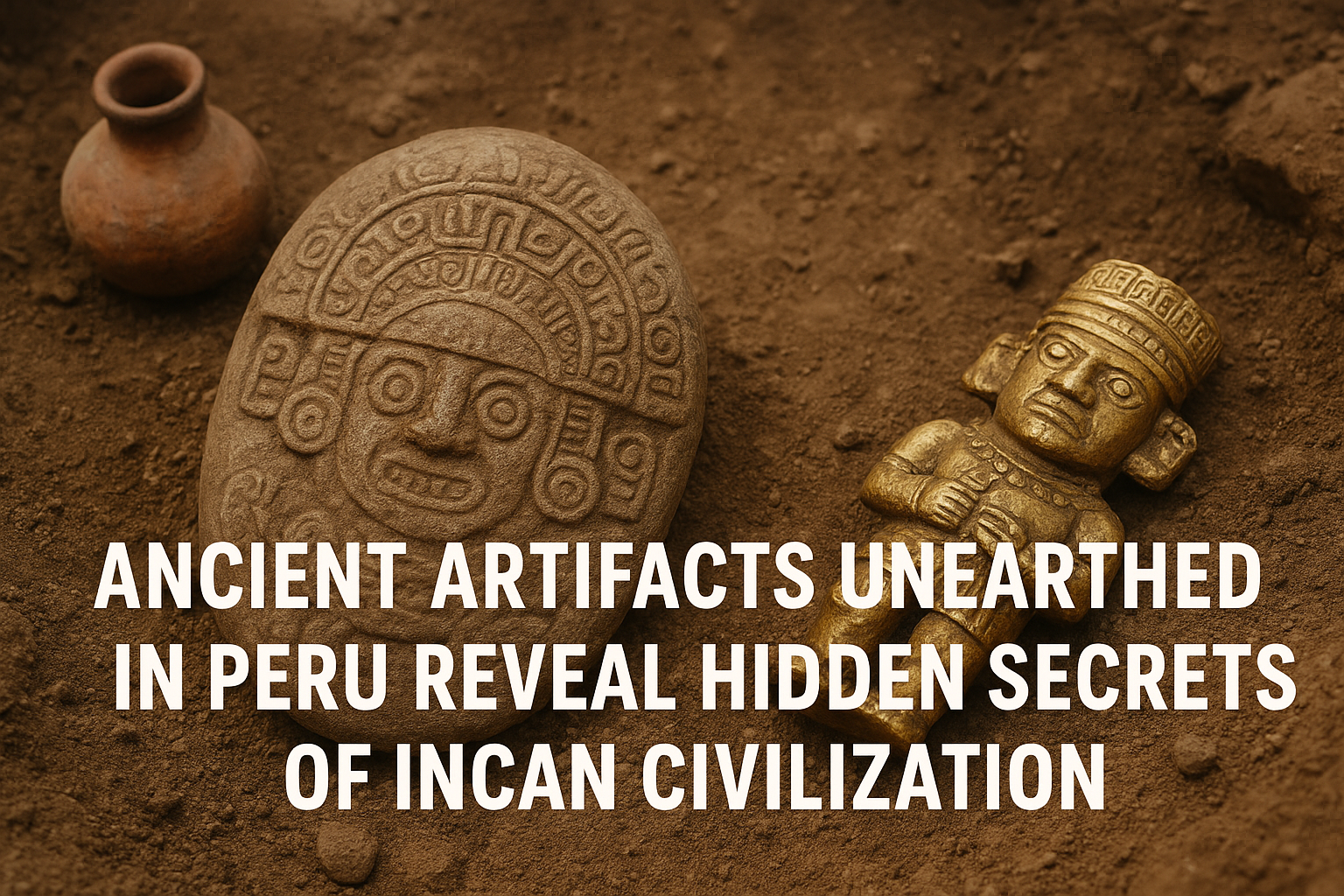

CUSCO, PERU — In a groundbreaking discovery that has captivated historians and cultural enthusiasts worldwide, archaeologists in the Andean region of Peru have unearthed a series of rare Incan artifacts that promise to illuminate previously unknown aspects of the ancient civilization’s daily life, spiritual practices, and societal structure.
The discovery, announced by the Peruvian Ministry of Culture, occurred near the sacred valley of Urubamba, a region long revered for its connection to the Incan empire. Over 200 artifacts, including intricately carved ceremonial objects, textile fragments, and pottery, were recovered during a carefully coordinated excavation conducted by a team of local and international archaeologists.
“These findings are exceptional in both quality and context,” said Dr. Mariana Velasquez, lead archaeologist on the project. “Each piece tells a story, offering us a glimpse into the spiritual and social dimensions of the Incan world that have long remained hidden.”
A Glimpse Into Incan Society
Preliminary analyses suggest that many of the artifacts were used in ritual ceremonies related to agricultural fertility, ancestor worship, and astronomical observation. Among the most striking finds are finely crafted ceremonial knives, golden ornaments, and delicate textile fragments woven with symbols representing sun deities and natural elements, central to Incan cosmology.
“These objects indicate a highly sophisticated understanding of art, symbolism, and spiritual practice,” said Dr. Luis Herrera, an anthropologist specializing in Andean cultures. “They demonstrate that the Incas were not only builders of monumental architecture like Machu Picchu but also highly skilled artisans and cultural innovators.”
The Role of Technology in Discovery
The excavation team employed a combination of traditional archaeology and modern technology, including ground-penetrating radar, 3D mapping, and drone surveillance. This approach allowed them to identify underground structures and burial sites without causing unnecessary damage to the delicate surroundings.
“Technology has been crucial in uncovering these sites responsibly,” explained Dr. Velasquez. “It ensures that the artifacts are documented in their precise locations, preserving the historical context that is essential for understanding their significance.”
Cultural and Educational Impact
The discovery has already sparked interest among cultural historians, anthropologists, and the general public. Several universities have expressed intentions to collaborate with the Peruvian Ministry of Culture to study the artifacts in detail and develop educational programs that will bring the rich heritage of the Incas to students worldwide.
Local communities are also deeply invested in the project. For many residents, these findings reaffirm the enduring legacy of the Incan civilization, inspiring cultural pride and a renewed appreciation for traditional practices and oral histories that have been passed down through generations.
“These discoveries are not just academic—they connect us to our roots,” said Ana Huaman, a local historian in Urubamba. “They remind us of the richness of our cultural heritage and the need to protect it for future generations.”
International Interest
Global interest has surged following the announcement. Museums in the United States, Europe, and Asia have reached out to Peru to negotiate potential exhibitions and collaborative research projects. Experts warn, however, that all artifacts will remain under Peruvian custody to ensure proper preservation and respect for local traditions.
UNESCO representatives praised the excavation as a model of ethical archaeology, highlighting how Peru has successfully combined scientific inquiry with community engagement and heritage conservation.
Next Steps for Research
The Ministry of Culture has announced that ongoing research will include carbon dating, textile analysis, and symbolic interpretation of the artifacts. These studies aim to construct a comprehensive picture of Incan life, religion, and governance.
Dr. Herrera emphasized:
“This is just the beginning. Each artifact, each symbol, opens a window into a civilization that continues to surprise us. There’s much more to learn about how the Incas interacted with their environment, their political structures, and the beliefs that guided their lives.”
Broader Implications
This discovery offers a broader lesson for the modern world: the enduring value of cultural heritage, the importance of preserving historical sites, and the incredible depth of human creativity across time. As global interest in history and cultural identity continues to rise, such findings remind us that the past still has stories to tell—stories that can shape our understanding of the present and inspire future generations.
As the artifacts undergo careful study, Peru has confirmed its commitment to educational outreach, museum exhibitions, and international collaboration, ensuring that these treasures are accessible for research and public appreciation without compromising their preservation.
Conclusion
The excavation in Urubamba represents more than just an archaeological success—it’s a celebration of cultural identity, historical knowledge, and human ingenuity. From the delicate weaving patterns to the gold ceremonial objects, each discovery reinforces the sophistication and complexity of the Incan civilization.
With continued research and global engagement, these artifacts are expected to reshape modern understanding of pre-Columbian South America, highlighting the Incas as pioneers in art, architecture, and spiritual life. This is a story of heritage, human curiosity, and the timeless allure of uncovering the mysteries of our past.