
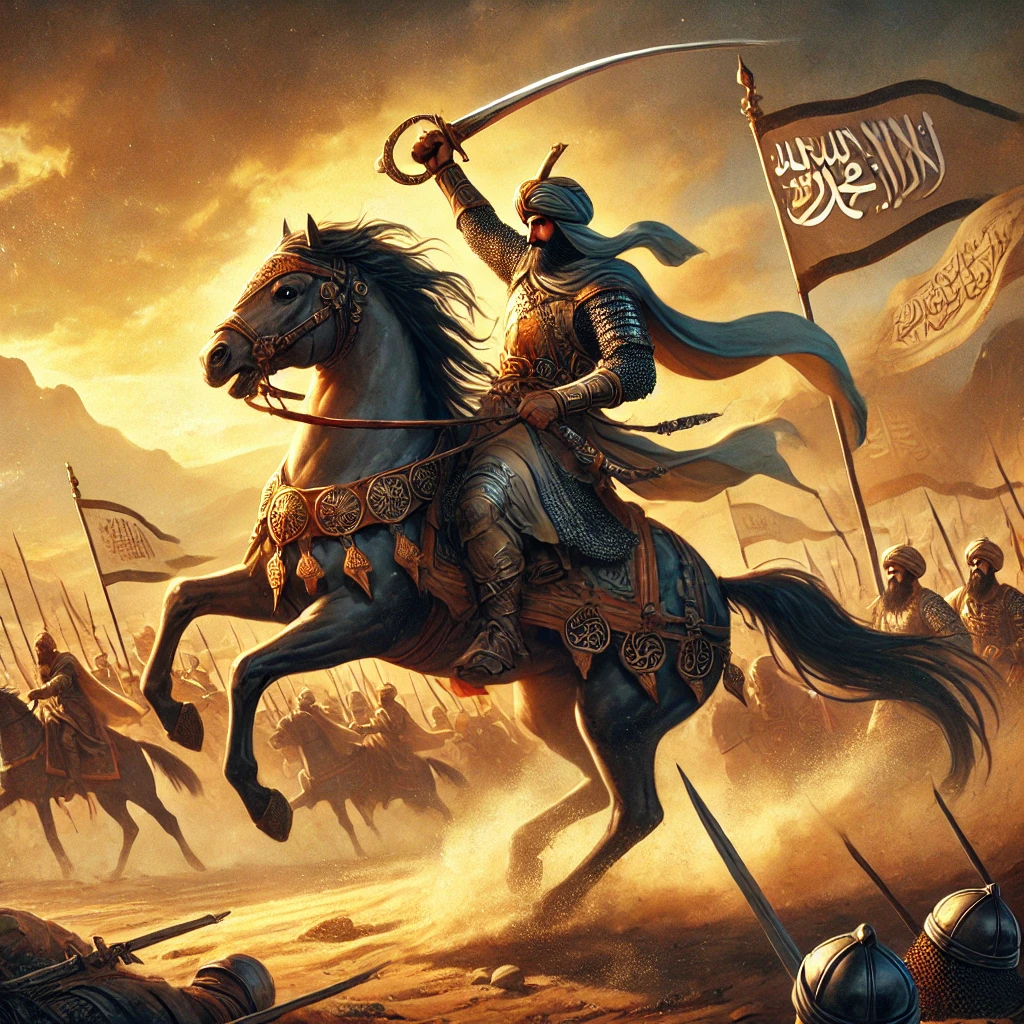

Khalid ibn al-Walid (RA): The Sword of Allah and Islam’s Greatest Military Commander
When it comes to military leadership and loyalty to Islam, few names shine brighter in the pages of history than Khalid ibn al-Walid (RA). Known as Saifullah al-Maslul (The Drawn Sword of Allah), Khalid was a companion of the Prophet Muhammad ﷺ and arguably one of the greatest generals the world has ever seen. With an undefeated record in over 100 battles, he reshaped the fate of empires through his unmatched strategic brilliance, personal courage, and total devotion to Islam.
📜 Early Life and Background
Khalid ibn al-Walid was born into the noble Banu Makhzum clan of the Quraysh tribe in Mecca. He came from a family of warriors and leaders; his father, Al-Walid ibn al-Mughira, was a powerful figure among the Quraysh. Trained from a young age in the arts of war, Khalid developed into a skilled horseman, swordsman, and tactician even before he accepted Islam.
Initially, Khalid opposed the Prophet ﷺ and even fought against the Muslims during the Battle of Uhud, where his leadership nearly turned the tide against the Muslims. But the destiny Allah had planned for him was much greater.
🕋 Conversion to Islam
Khalid converted to Islam in 629 CE (8th year after Hijrah) after reflecting deeply on the truth of the message and the integrity of Prophet Muhammad ﷺ. Upon his arrival in Medina, the Prophet ﷺ said:
“A man like Khalid cannot remain ignorant of Islam. If he would put his energy and skills in the way of Allah, he would do great things.”
Shortly after embracing Islam, he was given the title “Saifullah” by the Prophet ﷺ—a title no other companion was ever given.
⚔️ Unmatched Military Record
What makes Khalid ibn al-Walid’s legacy truly unique is his undefeated military career. No general before or after has recorded so many victories without a single defeat.
1. Battle of Mu’tah (629 CE)
His first command came unexpectedly during the Battle of Mu’tah, when three Muslim commanders were martyred. Despite being outnumbered 10 to 1 by the Byzantine forces, Khalid assumed command, reorganized the army, and successfully retreated without a complete loss—earning him his legendary title.
2. Battle of Yamama (632 CE)
During the caliphate of Abu Bakr (RA), Khalid led the campaign against the false prophet Musaylimah al-Kadhdhab. The battle was fierce, and Muslim losses were heavy, but Khalid’s tactics turned the tide. His leadership brought victory and unified the Arabian Peninsula once again.
3. Iraq and Persia Campaigns
Khalid led swift and brilliant attacks into Iraq (then under Persian rule), capturing key cities like Hira, Anbar, and Ayn al-Tamr, breaking Persian resistance with ease. His reputation spread across the region as an unstoppable force.
4. Battle of Yarmouk (636 CE)
Arguably his greatest achievement, Khalid led Muslim forces against a massive Byzantine army. His strategy, mobility, and ability to read the battlefield resulted in one of the most decisive victories in Islamic history, securing Syria for the Muslims and breaking Byzantine power.
🧠 Tactical Genius
Khalid was a pioneer of mobile warfare, multi-front attacks, and rapid maneuvering—centuries ahead of his time. He was famous for:
• Dividing his forces into highly mobile units.
• Using terrain to his advantage.
• Ambushing from unexpected directions.
• Psychological warfare and surprise night raids.
He also never hesitated to risk his own life in battle, often fighting in the front lines and rallying troops in the heat of combat.
🤲 Loyalty and Humility
Despite his unmatched victories, Khalid remained deeply humble. When Caliph Umar ibn al-Khattab (RA) removed him from command (to avoid people idolizing him), Khalid accepted the decision with no complaint, saying:
“I fight for the sake of Allah, not for Umar.”
This moment alone defines his sincerity and deep commitment to Islam over personal glory.
📚 Legacy and Death
Khalid ibn al-Walid passed away in 642 CE in Homs (present-day Syria), not on the battlefield but on his bed—something that caused him great sorrow. He reportedly said:
“I have fought in so many battles. There is no space on my body that is not covered by a scar… Yet here I die like a camel. May the eyes of cowards never sleep.”
His tomb in Homs remains a site of reverence and reflection to this day.
🌍 Why Khalid Matters Today
Khalid ibn al-Walid is more than a military hero. He is a symbol of devotion, courage, loyalty, and humility. He demonstrated that strength comes not just from the sword, but from the heart that wields it for truth and justice. In a world that often glorifies power without values, Khalid reminds us of the balance between bravery and faith