

Introduction: A Cosmic Surprise
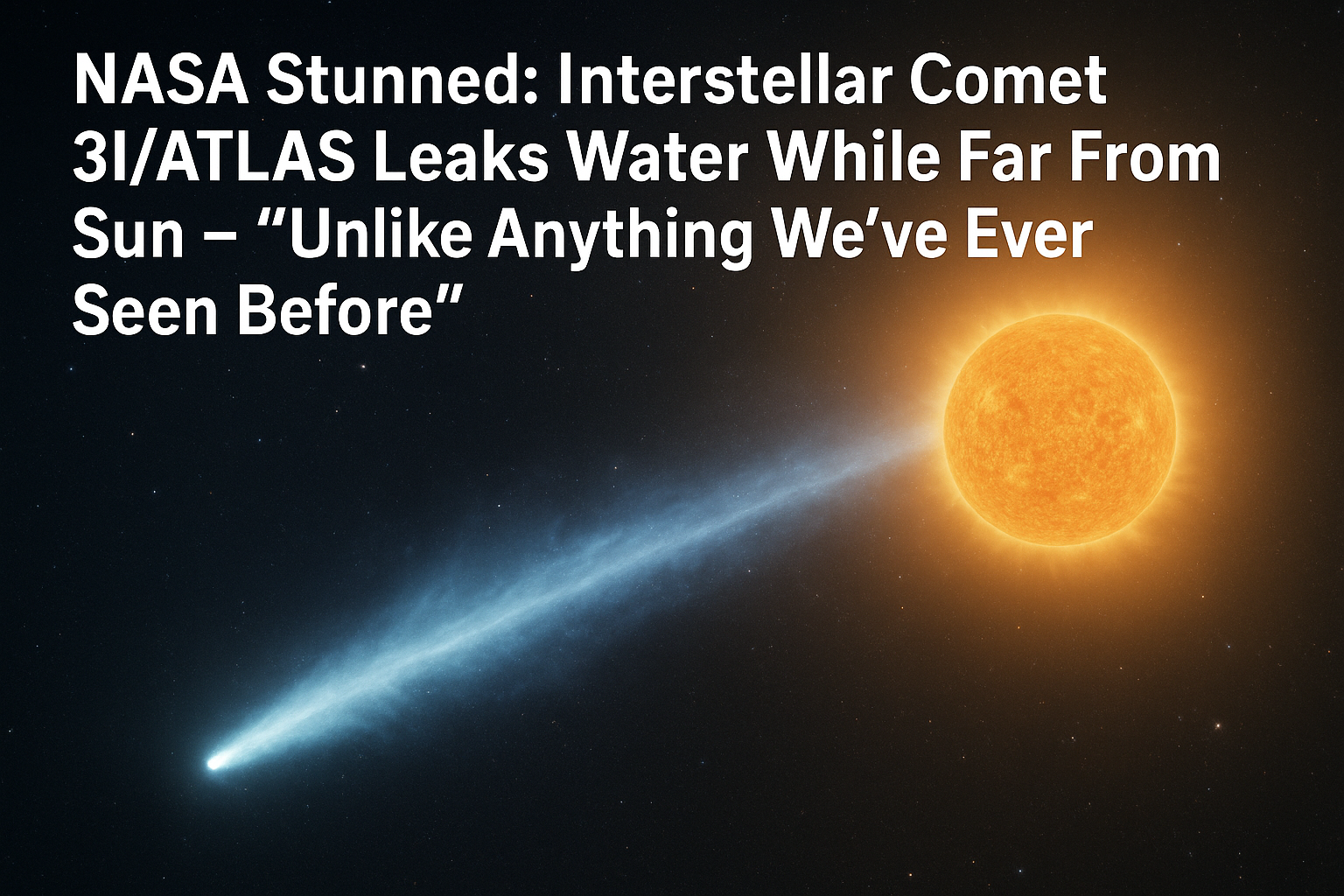
In a finding that has set the astronomy world alight, NASA scientists have discovered that interstellar comet 3I/ATLAS is leaking water vapor while still far from the Sun. This behavior is unlike anything ever witnessed before in interstellar objects. The discovery, made using observations from NASA’s Neil Gehrels Swift Observatory, reveals ultraviolet signals consistent with hydroxyl (OH) — a chemical signature that is a byproduct when water molecules break apart under sunlight.
What makes this phenomenon astonishing is the comet’s distance: 3I/ATLAS was observed nearly three times farther from the Sun than Earth when this water activity was detected. At that distance, temperatures are typically too cold for water ice to sublimate (turn into vapor), meaning scientists didn’t expect such visible water emissions.
The Data Behind the Discovery
The Swift Observatory captured ultraviolet emissions from 3I/ATLAS, which correspond to hydroxyl molecules produced when solar radiation splits water. This is usually one of the first clues that cometary ice is being heated and evaporated. But for 3I/ATLAS, this activity was observed at about 2.9 astronomical units (AU) from the Sun — that’s nearly three times the average Earth-Sun distance.
Analyses estimate that the comet is losing approximately 40 kilograms of water per second in vapor — comparable to a fire hose blasting water. That’s a surprisingly high loss rate, especially given the low solar heat available at that distance.
Researchers also noted that 3I/ATLAS exhibits other unusual features: a high CO₂ (carbon dioxide) to H₂O ratio, and a rather flat and straight trajectory compared to typical comets entering from interstellar space.
Why This Matters: Rethinking Comet Physics
For decades, comet science has operated under certain expectations:
- Comets begin to outgas (release vapor) when they get relatively close to the Sun, where solar heat can warm the icy material.
- Their chemical makeup, trajectory, and activity are generally predictable within known models.
3I/ATLAS challenges both assumptions. Its water leakage at great distance means that there might be other mechanisms or structures holding the water ice closer to the surface or in a porous form that allows sublimation even with weak solar input. Alternatively, there may be unusual insulating materials or internal heat sources.
If more interstellar comets show similar behavior, astronomers will need to rethink how comets form, their internal structures, and how they survive the long journey through cold space. It also raises questions about how common water may be spread across interstellar space — which ties directly into questions about the building blocks for life.
Implications for Habitability & Life’s Ingredients
Water is a key ingredient for life as we know it. When scientists find water or signs of water (or its breakdown products like hydroxyl) in interstellar objects, it suggests that the materials necessary for life are more widely distributed than previously thought.
3I/ATLAS, as an interstellar visitor, carries with it matter from outside our Solar System. That means its chemical signatures can tell us not just about how our own solar system works, but about the origins of comets in other star systems.
If comet behavior like 3I/ATLAS is more common, it may suggest that water — and thus some basic life-friendly chemistry — is not limited to inner solar systems near stars. It could be more pervasive in the galaxy, perhaps even laying groundwork for habitability farther from stars.
Expert Reactions and Theoretical Responses
The reaction from astronomers has been intense. Many voiced that this is one of the most unprecedented observations in interstellar comet science.
- Some theorists propose that the comet’s surface might have a thin insulating crust, keeping deep ice from sublimating until certain spots are exposed — hence the water release despite distance.
- Others suggest that micro-impacts by micrometeorites or cosmic rays may punch holes in this crust, enabling gas escape.
- There’s also talk of volatile-rich compositional variance: perhaps 3I/ATLAS has more volatile substances near its surface than expected, giving it more capacity to outgas at lower energy input.
But everyone agrees: the models must be updated. What we thought was a cold, inactive interstellar snowball might sometimes be far stranger and more dynamic.
Challenges & What We Don’t Know Yet
There are many questions still open:
- Exactly how stable the water leakage is: Is it continuous, or does it vary with rotation, exposure to sunlight, or other factors?
- How physically much water remains inside the comet, and how long it can sustain this kind of outgassing.
- Whether other interstellar comets exhibit similar behavior or if 3I/ATLAS is a rare outlier.
- What the implications are for comet dust, tail formation, and interactions with interstellar medium.
Possible Future Observations
Because this discovery is so recent, astronomers are planning follow-ups:
- Using other space observatories (optical, infrared, radio) to further map emissions and observe changes over time.
- Monitoring the trajectory and rotational dynamics of 3I/ATLAS to check if outgassing affects its path.
- Looking for similar behaviour in newly found interstellar comets or objects.
Conclusion: A Cosmic Game-Changer
Comet 3I/ATLAS is forcing us to expand our understanding of how objects behave in interstellar space. This isn’t just a cool space fact — it may rewrite textbooks about comets, solar systems, and maybe even about the distribution of water and the possibilities for life in the universe.
As we watch this comet drift through the cold expanses, leaking water where we didn’t think it could, we’re reminded that the cosmos still holds many surprises. And that the universe is far more dynamic and alive than many of us ever imagined.