
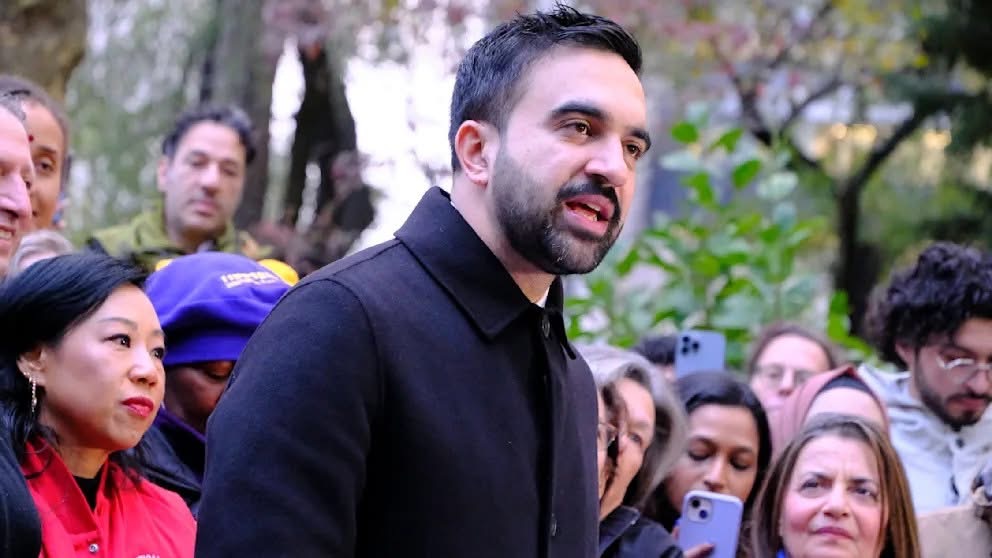

New York City – In a moment of rare candor on the campaign trail, mayoral candidate Zohran Mamdani addressed city voters who say they’re weary, distrustful—or simply “skeptical” of politicians.
“I don’t begrudge New Yorkers who are skeptical,” Mamdani said during a televised interview. “Because they’ve also lived through tens of millions of dollars of commercials…”
His statement strongly resonated across social media and news outlets, not only because it showed sensitivity to voter fatigue, but because it set the tone for a campaign built on accountability, transparency, and the promise of change.
🎙 What he meant by the remark
Mamdani’s reference to “tens of millions of dollars of commercials” speaks to the money and spin often associated with mayoral campaigns. His acknowledgement is twofold:
- First, he validates legitimate frustrations among voters who feel that political messaging often outweighs meaningful action.
- Second, he subtly sets a contrast: his campaign will aim to deviate from the usual patterns of heavy advertising and superficial promises.
By stating that he doesn’t “begrudge” skepticism, he implicitly invites voters to judge him on results rather than rhetoric.
🏙 Why this matters in the NYC mayoral race
New York City’s mayoral contest is already drawing intense scrutiny—both from local voters and national observers. Mammoth campaign budgets, powerful endorsements, and high-stakes policy agendas are defining the race. Amid such noise, Mamdani’s comments stand out as an attempt to speak directly to the citizen.
For many New Yorkers, trust in local government has eroded due to issues like rising costs, public safety concerns, transit delays, and lost neighborhoods. By front-loading his message with an admission of skepticism, Mamdani hopes to flip the narrative: not “Vote for me because I promise everything,” but rather “Let me earn your trust through how I deliver.”
📌 Key policy areas he ties to his message
Mamdani has outlined several priorities that connect back to his message on trust and skepticism:
- Public safety reform: focusing on community-led strategies and accountability.
- Affordable housing: promoting preservation and reducing displacement rather than only new construction.
- Transit reliability: arguing that broken promises about subway and bus service erode trust.
- Campaign finance transparency: pledging fewer big-money ads and more grassroots organizing.
His nod to the millions spent on commercials signals a broader critique of the status quo—where campaigns appear to invest heavily in image rather than infrastructure.
🧍 Voter sentiment and audience reaction
On platforms like X (formerly Twitter), Instagram, and Facebook, social posts referencing the quote have sparked engagement. Comments fall into patterns like:
“Finally someone acknowledging the reason we don’t believe them.”
“If he means it, he gets my vote.”
“I’ll believe it when the ads stop and the action starts.”
These responses indicate that a segment of New York’s electorate is hungry for authenticity. Mamdani’s framing of the issue—skepticism as understandable, but change as possible—positions him to capture that mood.
🔮 What to watch going forward
The real test will be whether Mamdani’s words translate into behavior. A few key signals to follow:
- Will his campaign drastically reduce ad spend compared to competitors?
- Will he highlight measurable achievements (in current office or past work) rather than mere intentions?
- Will his ground-game target neighborhoods often overlooked in past campaigns?
How the other major candidates respond could also shape the narrative. If they perceive Mamdani’s comment as a critique of big-budget campaigns, they may attempt to raise the stakes or pivot to emphasizing their own track records.
✅
Concluding thought
By saying “I don’t begrudge New Yorkers who are skeptical,” Zohran Mamdani opened the door to a different kind of campaign—one grounded in acknowledging the past and promising better delivery in the future. Whether that becomes a winning formula remains to be seen. But he’s made clear: he isn’t asking voters to blindly trust him; he’s saying, “Show me your support—and I’ll earn it.”