
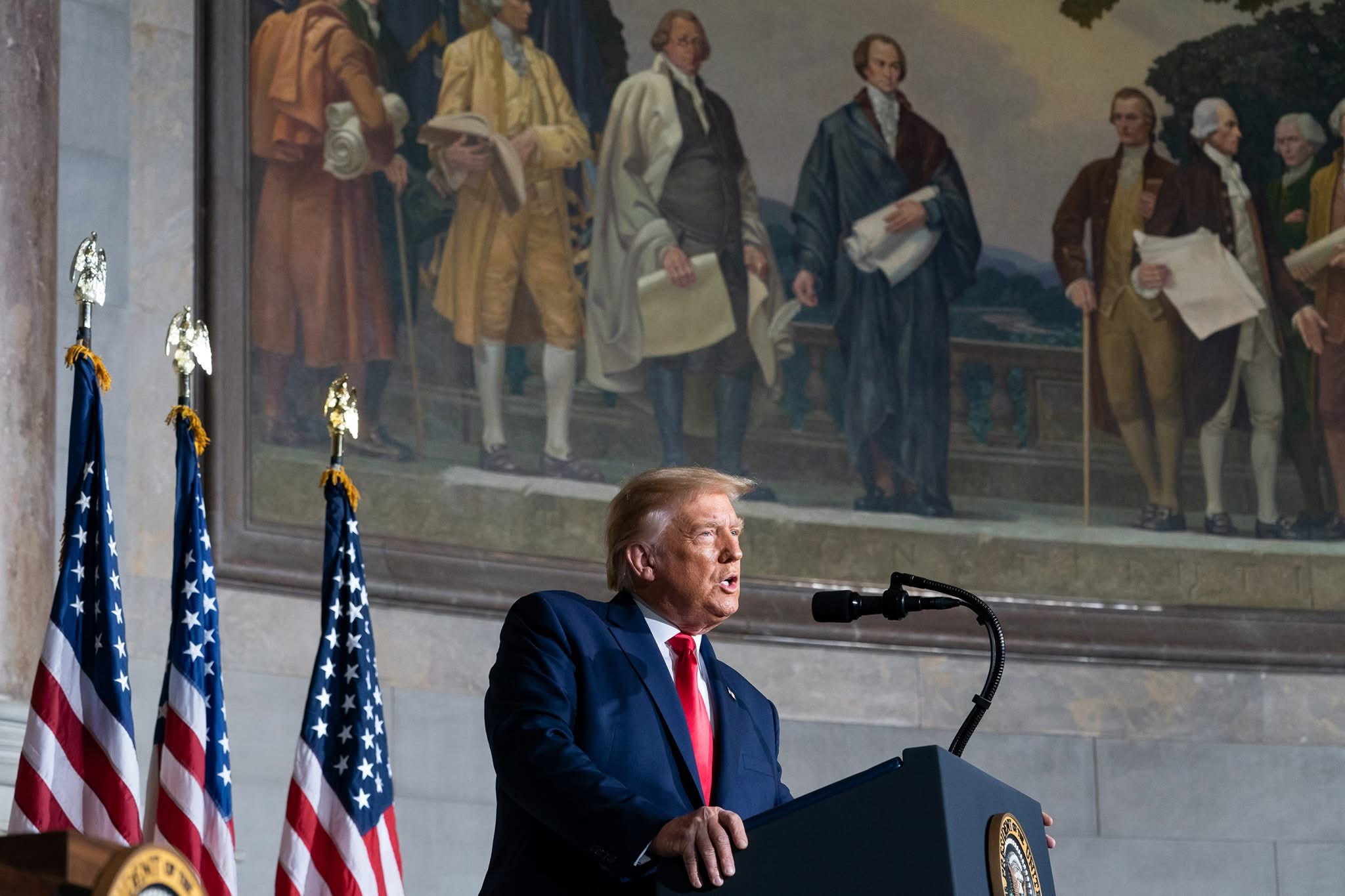

U.S. President Donald Trump has suggested that some of the hostages believed to still be alive in Gaza may have recently died, adding fresh uncertainty to the fate of dozens of people held since the October 2023 Hamas-led attacks. His comments came as Israel intensified military operations in Gaza City, urging Palestinians to evacuate southward ahead of what it describes as a decisive push against Hamas.
“It’s 20 people, but I think of the 20 there could be some that have recently died, is what I’m hearing. I hope that’s wrong,” Trump told reporters at the Oval Office on Friday. He added that U.S. negotiators are in “very deep negotiations with Hamas” to secure the release of remaining hostages, though he acknowledged the process had become increasingly difficult.
According to Israeli authorities, 47 hostages are still believed to be in Gaza, 27 of whom are presumed dead. Families of the captives, many of whom have openly challenged the Israeli government’s handling of the crisis, have previously demanded clarity on the number of surviving hostages.
On Saturday, the Hostages and Missing Families Forum avoided commenting directly on Trump’s remarks but thanked him for what it described as his commitment to “bring them home.” The statement coincided with the release of a rare Hamas video showing two hostages in Gaza City, one of whom warned that nine captives would die if Israel proceeded with its current military strategy.
The Israeli military claims it has established control over 40% of Gaza City and dropped thousands of leaflets urging civilians to move south to Khan Younis, designating Mawasi as a “humanitarian zone.” Military spokesperson Avichay Adraee said the relocation was essential to protect civilians, but humanitarian groups and many residents remain unconvinced.
The International Committee of the Red Cross (ICRC) rejected the evacuation plan, calling it “unfeasible and incomprehensible” given the devastation across Gaza and lack of infrastructure in designated safe areas. Palestinian residents interviewed by CNN echoed similar concerns, saying they would rather remain in their homes than face repeated displacement.
Meanwhile, mediation efforts led by Qatar, Egypt, and the United States remain stalled. Hamas has already accepted a proposal for a 60-day ceasefire, including the release of 10 hostages in exchange for a large-scale prisoner swap. Israel has yet to formally respond, with Prime Minister Benjamin Netanyahu insisting that Hamas must agree to disarm — a condition the group has refused.
Trump, who has maintained a high-profile role in U.S. foreign policy debates, warned that without an agreement, the situation would escalate further. “It’s going to be nasty — that’s my opinion,” he said. “They gotta let them out.” He also reminded reporters of the October 7 attacks, saying, “You have to put that into the equation very strongly.”
As the war in Gaza stretches on, the hostage crisis remains at the center of both international diplomacy and Israel’s domestic debate — a painful reminder of the human cost of the conflict.
Trump’s latest remarks highlight the fragility of the hostage negotiations and the deep uncertainty surrounding their outcome. By suggesting that some captives may already be dead, he underscores both the urgency and the limits of diplomacy in this crisis. His statements also show the delicate balance between applying pressure on Hamas and maintaining negotiations that could lead to even a partial release.
For Israel, the situation is increasingly complex. Military operations in Gaza City may strengthen its tactical advantage against Hamas but risk further endangering the lives of hostages. Humanitarian organizations, by calling mass evacuation “impossible,” signal the severe consequences of forcing civilians into overcrowded and undersupplied areas. This contradiction between military goals and humanitarian realities could intensify criticism of Israel internationally while deepening divisions within its society.
Hamas, meanwhile, continues to use hostages as leverage — not only against Israel but also within the broader geopolitical negotiations involving the U.S., Qatar, and Egypt. The stalemate suggests that without a breakthrough, both the humanitarian crisis and the political deadlock will persist.
Trump’s warnings may increase pressure on Israel and mediators, but they also reveal a central truth: the longer the conflict drags on, the fewer options remain for safely bringing the hostages home.