
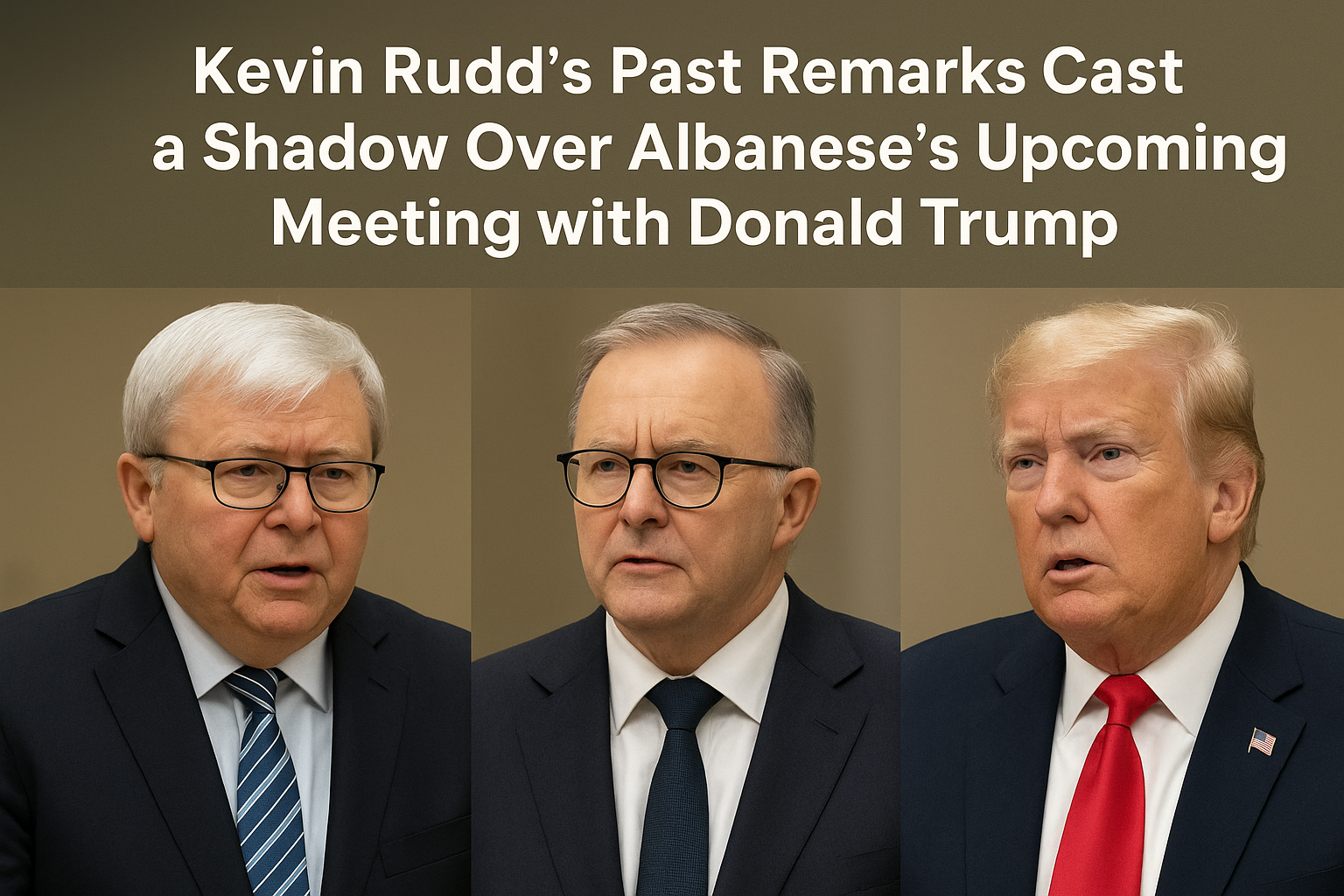

Rudd’s Words Echo Loudly in Washington
In the complex world of international diplomacy, timing is everything. As Australian Prime Minister Anthony Albanese prepares for his long-awaited meeting with former U.S. President Donald Trump, one man’s words from the past are unexpectedly echoing across Washington — Kevin Rudd, Australia’s current ambassador to the United States.
Rudd, who previously served as Australia’s prime minister, was appointed as ambassador in 2023 by the Albanese government — a move that drew both praise and skepticism. But his history of strong public criticism toward Donald Trump, dating back to Trump’s presidency, has resurfaced just as relations between Canberra and Washington are entering a sensitive new phase.
Now, as Albanese readies himself for a face-to-face with Trump — who remains a major political force in America and could return to the White House — questions are mounting over whether Rudd’s outspoken past could become a diplomatic liability.
A History of Sharp Words
Kevin Rudd was never one to hold back when it came to global politics. During Trump’s presidency, Rudd frequently criticized what he saw as “unpredictable” and “dangerous” foreign policy, especially regarding climate action, China, and NATO alliances.
In one 2018 opinion piece, Rudd accused Trump of “undermining the international order Australia depends on,” and in several televised interviews, he warned that Trump’s isolationist approach was “a fundamental risk to Western stability.”
Those statements, while celebrated by some progressives at the time, now hang like a shadow over his diplomatic post. In Washington’s political circles — especially within Trump’s orbit — memories are long.
Several American commentators have already resurfaced Rudd’s past quotes on social media, with one former Trump advisor describing him as “the least neutral ambassador ever sent to the U.S.”
Albanese Caught in a Diplomatic Balancing Act
For Prime Minister Anthony Albanese, the timing couldn’t be more delicate. His government has worked hard to deepen the U.S.–Australia alliance through defense cooperation, trade partnerships, and the landmark AUKUS security pact.
But with Trump poised for a potential political comeback, the Albanese administration knows it cannot afford friction — especially not over personal politics.
Sources within the Department of Foreign Affairs and Trade (DFAT) told reporters that “Rudd’s past remarks are a known factor,” but stressed that “the ambassador has been fully professional and constructive in his current role.”
Still, optics matter. If Trump or his allies perceive Rudd’s presence as an insult or a reminder of past criticism, it could make for an awkward encounter when Albanese and Trump finally sit down together — either in Washington or at a global summit.
Diplomacy in the Age of Personality Politics
International diplomacy has always required tact and patience. But in today’s world — where politics are driven by personalities and viral headlines — even old tweets or interviews can carry unexpected weight.
Trump, known for his direct and often retaliatory communication style, has previously clashed with leaders who criticized him in the past. Analysts warn that even a subtle perception of disrespect can influence how Trump views bilateral partnerships.
Dr. Elaine Brooks, a political analyst at the Brookings Institution, noted:
“It’s not about policy alone anymore. It’s about loyalty and optics. For someone like Trump, how a country treated him in the past still matters deeply in how he approaches future negotiations.”
If that holds true, Rudd’s previous characterizations of Trump as a “global destabilizer” could complicate things for Albanese — even if the ambassador himself avoids any direct involvement in the upcoming talks.
The White House Angle
Inside Washington, the Biden administration remains Australia’s current closest ally. Yet, many observers note that Canberra must also prepare for the possibility of a Trump resurgence — a return that could reshape global power structures overnight.
“The Albanese government is walking a fine line,” said a former U.S. diplomat familiar with Indo-Pacific affairs.
“They’ve built strong ties with Biden on climate and defense, but they also know that Trump could come back with a very different worldview. Having Kevin Rudd as ambassador complicates that calculus.”
In private, Australian officials are said to be quietly discussing contingency plans — including whether a future Trump administration might request a different diplomatic representative. For now, though, both Rudd and Albanese are focused on maintaining what they describe as “a strong, bipartisan alliance that transcends political cycles.”
What Trump Might Say (or Tweet)
While Trump has not publicly addressed Rudd’s comments, political insiders are watching his social media channels closely. The former president is known for bringing up old remarks at inopportune times — and his team’s rapid-fire style of online engagement means even a single resurfaced quote could ignite controversy.
“Trump doesn’t forget who criticized him,” said political strategist Jake Matthews. “If Rudd’s name comes up in conversation, it could trigger a very public response — and that’s the last thing Albanese wants heading into this meeting.”
The Stakes for Both Countries
Australia’s relationship with the United States is one of its most critical international partnerships — anchored in shared democratic values, defense cooperation, and economic investment.
If tensions were to arise — even symbolically — it could ripple across issues from security to trade. Both countries are currently navigating complex challenges in the Indo-Pacific, with rising tensions involving China, North Korea, and Taiwan.
Analysts say the upcoming meeting between Albanese and Trump could be a key test of Australia’s ability to maintain a steady, bipartisan relationship regardless of who occupies the White House.
Rudd’s Response — Silence or Strategy?
So far, Kevin Rudd has avoided public comment on the controversy. In his recent media appearances, he’s focused on issues like renewable energy, cybersecurity, and expanding educational exchange programs between Australia and the United States.
Those close to him say he’s “well aware” of how his words are being interpreted but is committed to maintaining professionalism.
One source close to the embassy said:
“Ambassador Rudd knows that diplomacy sometimes means letting your past words fade quietly into the background. His focus now is on what unites the two nations — not what divides them.”
A Delicate Dance Ahead
As Albanese’s meeting with Trump approaches, both leaders face a test of maturity and pragmatism. The world will be watching whether personal histories can be set aside for national interests.
Whether or not Rudd’s past statements resurface during private discussions remains to be seen, but one thing is certain — in global politics, no word ever truly disappears.
As Dr. Brooks summarized:
“Diplomacy isn’t just about what you say today. It’s about what you said years ago — and how you make it right.”