
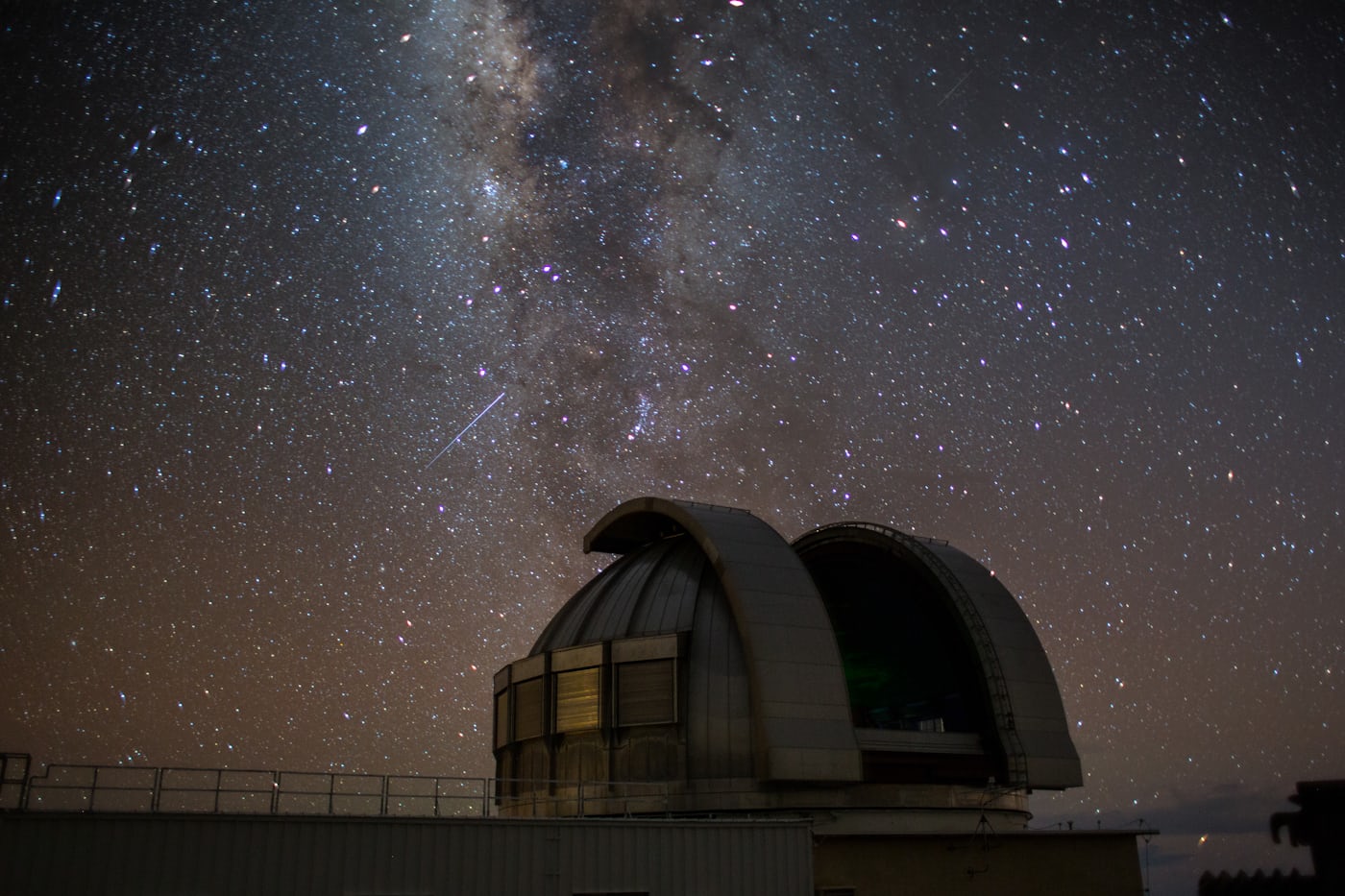

At the center of our galaxy lies a mysterious gamma-ray glow that has baffled astronomers since NASA’s Fermi Gamma-ray Space Telescope first detected it in 2008. The glow’s origin has long been debated — could it be caused by pulsars, the spinning remnants of dead stars, or by colliding particles of dark matter, the invisible substance thought to make up most of the universe?
A new study from Johns Hopkins University, published in Physical Review Letters, adds a surprising twist. Using advanced supercomputer simulations, researchers found that dark matter in our galaxy may not be spherical as previously believed, but flattened — resembling the Milky Way’s central bulge, where the glow is strongest. This new model aligns closely with the Fermi data.
“There’s about a 50% chance this glow comes from dark matter,” said Joseph Silk, coauthor of the study. “That’s a huge step toward understanding what this mysterious stuff really is.”
The upcoming Cherenkov Telescope Array (CTAO), set to begin operations in Chile and Spain by 2027, will deliver much sharper gamma-ray observations. It could confirm whether the glow truly comes from dark matter collisions — potentially solving a cosmic mystery dating back to Fritz Zwicky’s 1930s theory and Vera Rubin’s 1970s observations.
Still, experts like Tracy Slatyer from MIT caution that while the new simulations are promising, direct evidence remains elusive. Nico Cappelluti of the University of Miami summarized it best: “This mystery keeps us awake at night — because if those gamma rays come from dark matter, we’re on the verge of uncovering one of the universe’s greatest secrets.”

This study doesn’t solve the mystery yet, but it reshapes how scientists think about dark matter’s structure and influence. Whether or not dark matter is behind the gamma-ray glow, these simulations mark a major leap in our understanding of galactic evolution. Humanity stands on the edge of discovery — one that could redefine physics itself.