
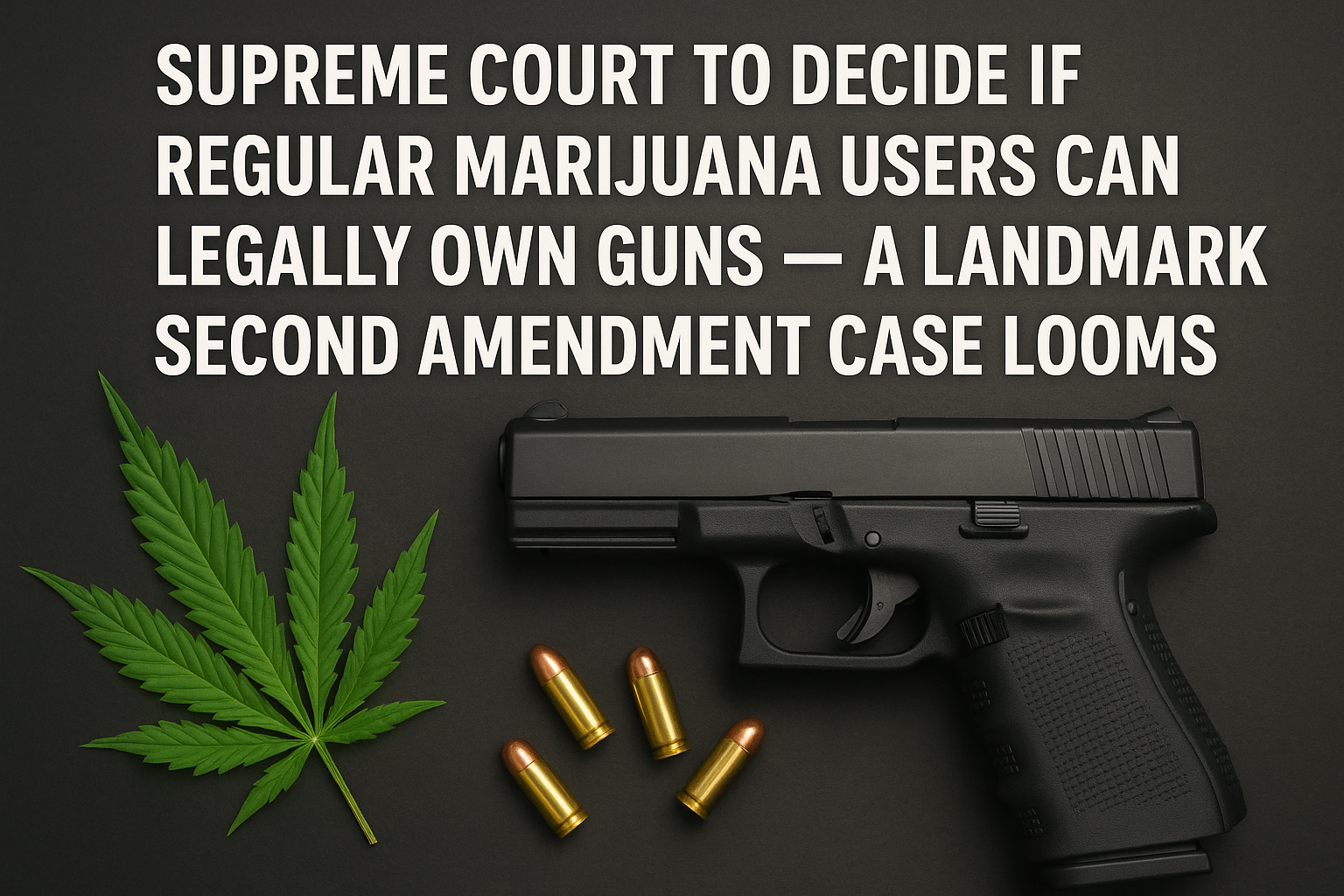

Supreme Court to Weigh Gun Rights for Marijuana Users
Washington, D.C. — The U.S. Supreme Court announced Monday that it will take up a case that could redefine the boundaries of gun ownership rights for millions of Americans who use marijuana — testing the collision point between Second Amendment protections and federal drug prohibitions.
The case stems from a challenge by Patrick Daniels, a Texas man charged with a federal felony for possessing a firearm while admitting to being a regular marijuana user. The federal government, under guidance from the Justice Department, asked the Court to revive the case after lower courts ruled in Daniels’s favor, citing that the federal gun ban for cannabis users violated the Constitution.
The Court’s decision to hear the case sets the stage for one of the most consequential legal showdowns involving gun rights and cannabis policy in decades.
Background: Guns, Cannabis, and the Law Collide
Under federal law, marijuana remains a Schedule I controlled substance — the same category as heroin and LSD — even though it’s legal for medical or recreational use in 24 states.
That federal classification means anyone who “uses or is addicted to” marijuana is prohibited from purchasing, owning, or possessing firearms under 18 U.S.C. § 922(g)(3).
For years, this statute has sparked controversy and confusion, especially as the number of legal cannabis users has surged. Gun owners in states like Colorado, California, and Michigan have repeatedly found themselves caught between state legalization and federal prohibition — a legal limbo that the Supreme Court may finally clarify.
The Texas Case That Sparked the Debate
Patrick Daniels was stopped by police in Mississippi in 2022 for a routine traffic violation. Officers found two handguns in his vehicle and small amounts of marijuana. Daniels told authorities he used marijuana regularly but was not under the influence at the time.
He was later charged with being an “unlawful user of a controlled substance in possession of a firearm,” a federal felony carrying up to 10 years in prison.
Daniels argued that his Second Amendment rights were being infringed upon, especially since marijuana use is now legal under state laws in much of the country. A federal appeals court agreed, ruling in 2023 that the ban could not be constitutionally applied to him.
But the Biden administration, echoing a position earlier held by the Trump administration, appealed to the Supreme Court, arguing that the federal government has a vested interest in keeping guns out of the hands of people who “habitually use illegal drugs.”
What’s at Stake
At the core of the case lies a profound constitutional question:
Can an American who legally uses marijuana under state law still exercise their right to bear arms under the federal Constitution?
The Justice Department says “no,” asserting that drug users are more likely to act recklessly or irresponsibly with firearms.
But gun-rights advocates and civil-liberties groups argue that marijuana users are being unfairly targeted — especially in light of the 2022 Supreme Court ruling in New York State Rifle & Pistol Association v. Bruen, which expanded gun-carrying rights and tightened scrutiny on gun restrictions.
“Millions of law-abiding Americans use marijuana responsibly,” said Robert Barnes, a constitutional attorney. “If the government can take away their Second Amendment rights for that, it opens the door to countless other restrictions based on lifestyle rather than conduct.”
The Bigger Picture: Federal vs. State Tensions
The issue underscores the growing tension between state and federal law in America’s evolving cannabis landscape.
While more states embrace legalization — and even expunge past marijuana convictions — the federal government continues to classify cannabis as illegal, keeping users vulnerable to federal prosecution and firearm restrictions.
This clash of legal frameworks has left law enforcement agencies, courts, and ordinary citizens in confusion. Gun owners with medical marijuana cards, for instance, can be denied firearm purchases under federal background checks.
For example, in Colorado and Nevada — both states with thriving recreational cannabis markets — local sheriffs have been instructed not to issue concealed-carry permits to registered marijuana users, citing federal law.
What Legal Experts Are Saying
Legal scholars say the case could redefine how constitutional rights apply to Americans whose lifestyles don’t align neatly with federal policies.
“This is about more than weed and weapons,” says Georgetown law professor Linda Morrison. “It’s about the limits of federal power in regulating private behavior when state governments are moving in a completely different direction.”
If the Court rules in favor of Daniels, the decision could effectively dismantle the marijuana-related gun ban nationwide, giving millions of cannabis users the same firearm rights as alcohol consumers.
If it rules against him, the federal government’s stance will be reaffirmed — reinforcing the idea that using a federally illegal substance automatically forfeits certain constitutional privileges.
Political Reactions: A Divided Landscape
The case has already reignited political debates on Capitol Hill.
Republicans, led by pro-gun lawmakers, have framed the issue as another overreach of federal power. Senator Rand Paul (R-KY) posted on X:
“If a person can drink a beer and own a gun, they should be able to smoke a joint and own one too.”
Democrats, meanwhile, are more divided. Some progressive lawmakers support easing restrictions for responsible cannabis users, while others warn that mixing drugs and firearms remains a public-safety risk.
The National Rifle Association (NRA) and National Organization for the Reform of Marijuana Laws (NORML) — two groups rarely on the same side — have both expressed cautious support for Daniels’s appeal, calling for “a common-sense alignment between state legality and federal rights.”
When Will the Supreme Court Decide?
The case, officially titled United States v. Daniels, will be argued during the Court’s upcoming term, with a decision expected by mid-2026.
Until then, the ruling of the lower court — that the federal gun ban cannot be applied to Daniels — remains in effect in parts of the Fifth Circuit, which includes Texas, Louisiana, and Mississippi.
Observers expect a closely divided 6-3 decision, mirroring ideological fault lines similar to previous Second Amendment cases.
Why It Matters
Beyond the headlines, the outcome could have sweeping implications:
- Affecting millions of cannabis users nationwide.
- Shaping how the federal government reconciles outdated drug laws with modern social policy.
- Setting new precedent on how lifestyle choices interact with constitutional freedoms.
“This isn’t just a case about a man and a gun,” Morrison adds. “It’s a test of whether the Constitution still applies equally to all Americans — even those who light up after work instead of opening a beer.”
Conclusion
As the Supreme Court prepares to hear arguments, the case of United States v. Daniels will test the balance between personal freedom and public safety, between federal power and state rights, and between modern life and 20th-century law.
Whichever way the Court rules, the decision will ripple far beyond Texas — shaping the future of gun ownership, cannabis policy, and individual liberty in America.